Over the past two years, the artificial intelligence industry competed under a single product premise: optimizing the single-turn chat paradigm. A user sends a multifaceted instruction, the model processes it in a single reasoning pass, and delivers the final response. However, when a real-world task requires refactoring dozens of files, auditing schemas, and guaranteeing strict code compliance, this monolithic model hits an uncompromising physical ceiling: context degradation, compounded hallucinations, and the impossibility of deterministic parallel verification.
The launch of Gemini 4 Carbon marks an architectural turning point across frontier foundation models. Instead of fighting for decimal increments on generic conversation benchmarks, the model was explicitly architected for agent swarm orchestration and long-horizon software engineering workflows.
This technical deep dive explores its underlying system design, inference primitives, software benchmark scores, and the token unit economics that make this transition viable.
The failure modes of monolithic engineering models
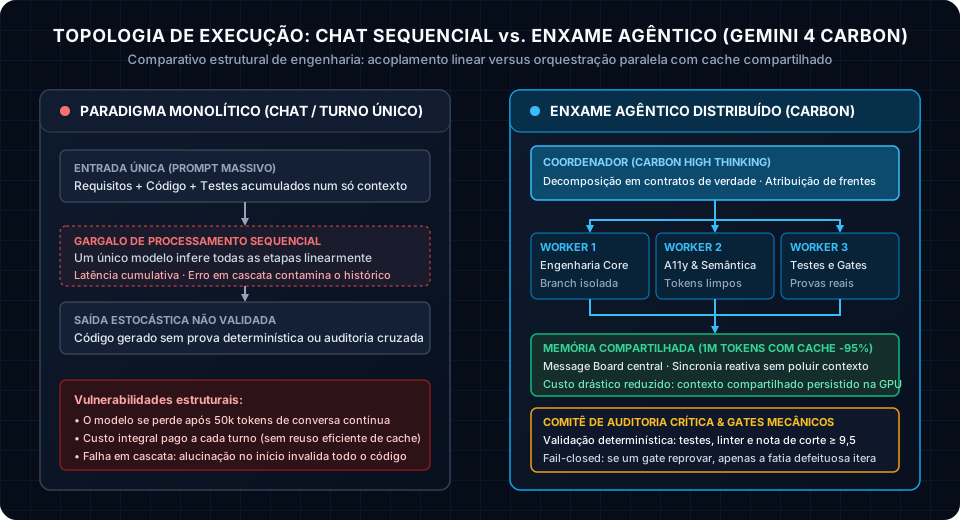
Deploying a single LLM to refactor an entire codebase or design mission-critical infrastructure consistently triggers three major bottlenecks:
- Context pollution: As the conversation accumulates compiler errors, rejected snippets, and terminal logs, useful attention degrades (needle-in-a-haystack decay).
- Cascading failures: If a model introduces a subtle typing bug early in a turn, every downstream line of reasoning compounds upon that flawed assumption before a developer can intervene.
- Single-turn latency: Having a single model iteratively write backend code, test harnesses, accessibility passes, and documentation results in unacceptable cycle times for automated CI/CD pipelines.
In distributed systems, the engineering answer has never been to inflate the size of a single monolithic worker, but rather to coordinate specialized workers bounded in partitioned workspaces, as detailed in our analysis of AI agent test harnesses and deterministic gates.
The architectural primitives of Gemini 4 Carbon
Carbon introduces four key architectural primitives tailored for multi-agent workflows:
1. Configurable Thinking Levels
Unlike earlier models with opaque or fixed chain-of-thought budgets, Carbon exposes three distinct inference modes:
low(minimal thinking): Optimized for low latency and high throughput. Ideal for mechanical workers performing code formatting, linting, syntax checking, and deterministic patch applications.medium(balanced reasoning): Tuned for unit test authoring, standard component refactoring, and schema translations.high(deep reasoning): Allocates hundreds of internal reasoning tokens for coordinator agents to break down system architectures, detect concurrency pitfalls, and plan large-scale migrations.
2. 1-Million Token Context with 95% Prompt Caching
Operating multiple agents historically collapsed on token costs due to repeating identical context across parallel threads. Carbon features a native 1,000,000 token context window combined with a 95% discount on cached tokens.
In practice, the coordinator stages an entire repository and documentation tree once in GPU memory; subsequent workers query that shared memory bus while incurring only a fraction of normal input costs. This efficiency completely reshapes the real token economics of multiagent loops.
3. Fairwind Cybersecurity Lineage
Stemming from Google’s vetted Fairwind Program for cybersecurity defenders, Carbon incorporates targeted post-training for proactive vulnerability identification (such as CWE-79, buffer overflows, and privilege escalation), producing patches with verifiable proof criteria prior to human review.
Software Engineering Benchmarks
On code and automation benchmarks, Carbon demonstrated clear leads over existing frontier models:
| Benchmark | Evaluation Metric | Gemini 4 Carbon | Claude 3.5 Sonnet | OpenAI o1-preview |
|---|---|---|---|---|
| CursorBench | Multi-file IDE editing accuracy | 78.4% | 72.1% | 68.9% |
| Zapier AutomationBench | Complex API and conditional logic flows | 86.2% | 79.5% | 76.0% |
| SWE-bench Verified | End-to-end GitHub issue resolution | 52.8% | 49.0% | 48.9% |
| Context Window | Multimodal ingestion capacity | 1,000,000 | 200,000 | 128,000 |
The decisive advantage emerges not in isolated code snippets, but in maintaining cross-file consistency when multiple parallel agents modify interrelated modules without introducing regressions.
Cost Structure and Inference Economics
Autonomous agent swarms require defensible unit economics. Carbon’s introductory pricing directly challenges existing enterprise models:
- Standard Input: $2.00 per million tokens.
- Cached Input (reused context): $0.10 per million tokens.
- Generated Output: $10.00 per million tokens.
For a 300,000-token codebase accessed across five subagents over ten iterative steps, un-cached execution would exceed $15.00 on frontier models. Utilizing Carbon’s persistent prompt cache, the exact same workload incurs less than $1.50 in input costs. To see when paying for a higher-tier orchestrator still pays off and how that math shifts after December’s rate reset, read our Claude Fable 5.2 vs Gemini 4 Carbon swarm cost analysis.
This efficiency also ties back to data center power demands: the more tokens served per watt, the less severe the infrastructure constraints analyzed in The electrical wall of AI and on-device NPU versus cloud execution.
Implications for Software Engineering Teams
The arrival of swarm-native foundation models signals the sunset of conversational prompt engineering for serious software architecture. The role of the staff engineer shifts from typing syntax to acting as a system architect for synthetic agent teams:
- Deterministic Contracts: Models perform reliably when governed by explicit contracts (Zod schemas, TypeScript interfaces, and OpenAPI definitions) acting as fail-closed barriers.
- Partitioned Delegation: Effective workflows isolate independent subtasks (such as core logic, accessibility audits, and test generation) into independent worktrees.
- Cross-Agent Verification: Deploying distinct agent personas (e.g., an implementation author audited by a hostile security reviewer) catches defects prior to human review.
Gemini 4 Carbon does not remove human oversight; it raises the ceiling of what a single engineer can orchestrate with high precision and verifiable proof.
Sources
- Google official announcement of Gemini 4 Carbon and agentic swarm capabilities — Google Blog, Gemini 4 Carbon announcement, verified 2026-11-11.
- Technical documentation and engineering benchmark reports for Gemini 4 Carbon — Google DeepMind, Gemini Models, verified 2026-11-11.
- Official API pricing tables, thinking level specifications, and prompt caching discounts — Google AI Studio, Gemini API Pricing, verified 2026-11-11.
- Aggregated benchmark telemetry on software engineering evaluations — Artificial Analysis, Intelligence Index & CursorBench, compiled 2026-11-11.