During the first years of the generative artificial intelligence boom, the industry’s big bottleneck had an almost universal name: a shortage of silicon. Whoever managed to buy or rent thousands of top-tier GPUs led development; whoever stayed in the semiconductor queue watched from the outside.
That picture changed quietly and irreversibly. The biggest barrier to the advance of frontier models in 2026 is no longer the silicon from the factories in Taiwan, but the copper wire of the high-voltage grid and the capacity of the electrical generators.
To keep building AI supercomputers, companies such as Microsoft, Google, and Amazon stopped being merely ordinary consumers of computing services and entered the power sector directly, signing billion-dollar agreements to restart decommissioned nuclear plants and to finance small modular reactors.
This post is an analysis grounded in public energy-infrastructure data, reports from the International Energy Agency (AIE / IEA), and regulatory records of power contracts. The goal is to explain why the physics of modern computing ran into the power grid and what that race means for technology and for society.
The physics of inference: why AI consumes orders of magnitude more energy
To understand AI’s energy crisis, you have to demystify what happens when a machine “thinks”.
When you run a traditional web search, the server only has to consult an inverted index in memory, apply ranking rules, and return static links. According to a survey by the International Energy Agency (AIE) in the Electricity 2024 report, a typical query on Google’s search engine consumes on average about 0.3 watt-hours (Wh) of electricity.
When you interact with an advanced language model — especially frontier models that use deliberative reasoning (Test-Time Compute) to plan, self-correct, and debate with themselves before answering — the processing requires multiplying billions of parameters across thousands of tokens generated in sequence.
- Classic web search: ~0.3 Wh per request.
- Query with a standard generative model: ~2.9 Wh per request (almost 10 times more than an ordinary search).
- Agent runs and deep reasoning: from 10 to 35 Wh per complex multi-step task.
Multiply that consumption by hundreds of millions of daily active users and the result stops being a software-efficiency metric and becomes a macroeconomic impact on any country’s power mix. The AIE projects that global electricity consumption by data centers, which was approximately 460 terawatt-hours (TWh) in 2022, may pass the mark of 1,000 TWh by the end of 2026 — the equivalent of the annual electricity consumption of an industrialized country such as Japan.
The density jump: from 10 kW to 120 kW per rack
The impact is not only in the total amount of energy, but in the thermal concentration per square meter inside the data center.
Historically, a traditional data center for corporate hosting or web servers was designed to support racks with an average density of 5 to 10 kilowatts (kW). Racks of that kind are cooled comfortably with industrial air conditioning and cold-air circulation in pressurized aisles.
Modern AI computing broke that architecture:
| Characteristic | Classic Web Data Center | AI Supercomputing Data Center |
|---|---|---|
| Power density per rack | 5 kW to 10 kW | 40 kW to more than 120 kW (e.g., NVL72 architectures) |
| Cooling method | Air cooling (fans) | Direct liquid cooling on the chip (Direct-to-Chip Liquid Cooling) |
| Energy-demand profile | Variable, with daytime traffic peaks | Stable continuous load at 100% (flat line) 24/7/365 |
| Critical point of failure | Network outage or latency | Thermal oscillation and interruption of the electrical supply |
When a rack consumes 120 kW of electricity, it dissipates practically all of those 120 kW as heat in a space the size of an office cabinet. Air simply does not have enough thermal conductivity to carry that much heat outside; that is why leading-edge AI servers today require circuits of demineralized water flowing directly over copper cold plates bonded to the chips.
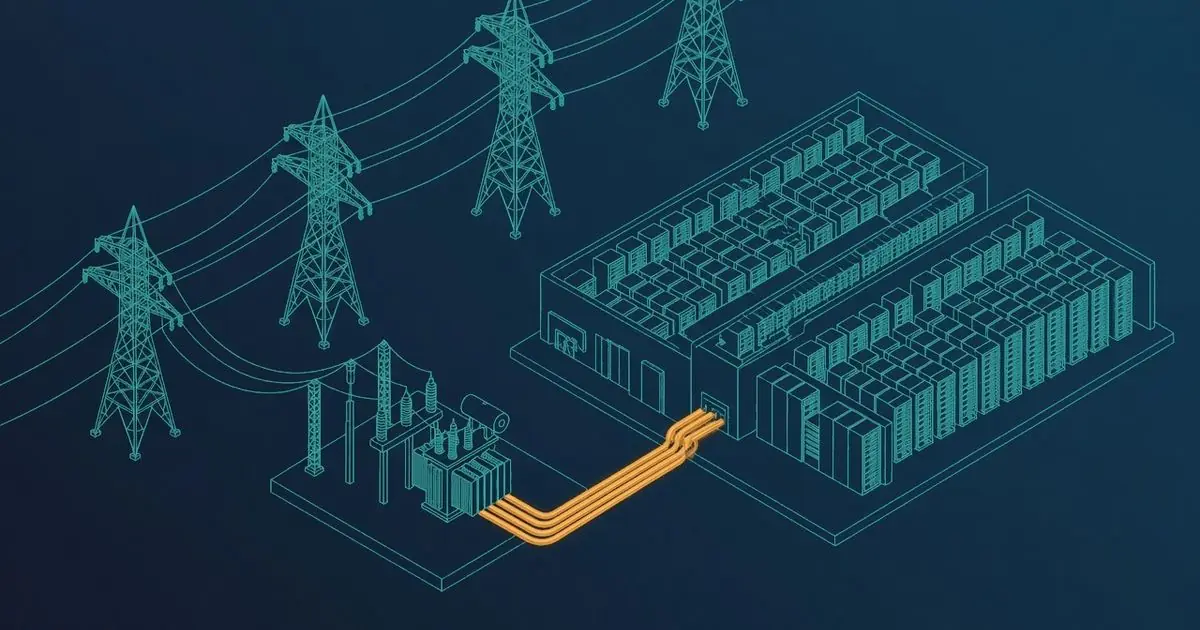
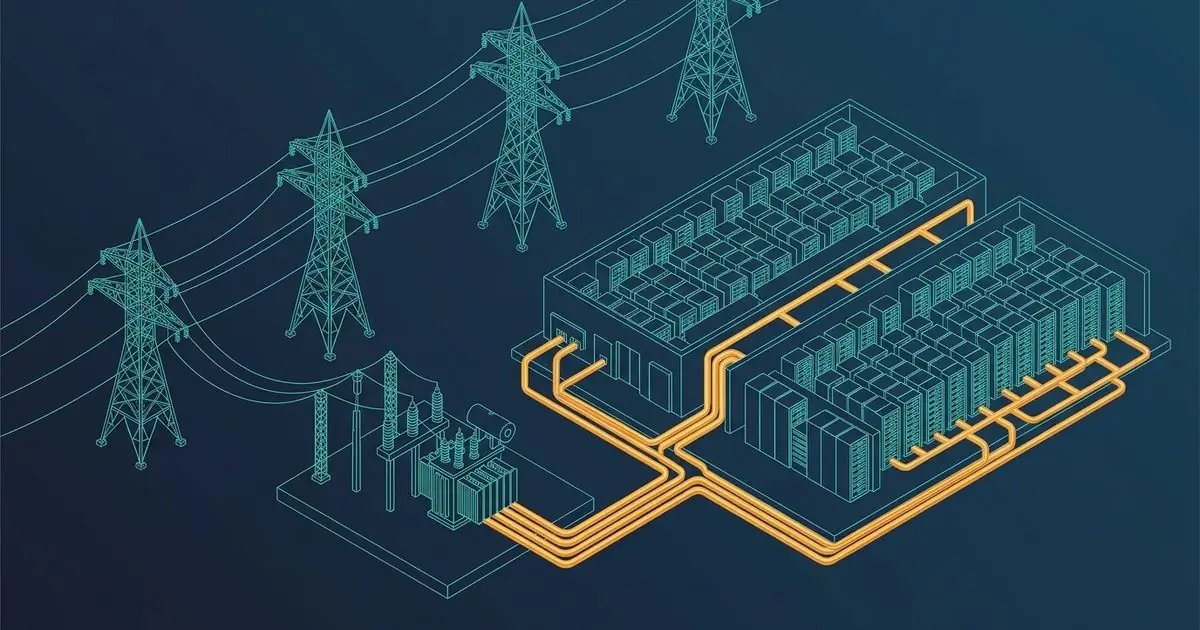
More than that: a campus with hundreds of these racks requires substations of 300 MW to 1 GW of dedicated capacity — the same electricity consumption required by hundreds of thousands of homes.
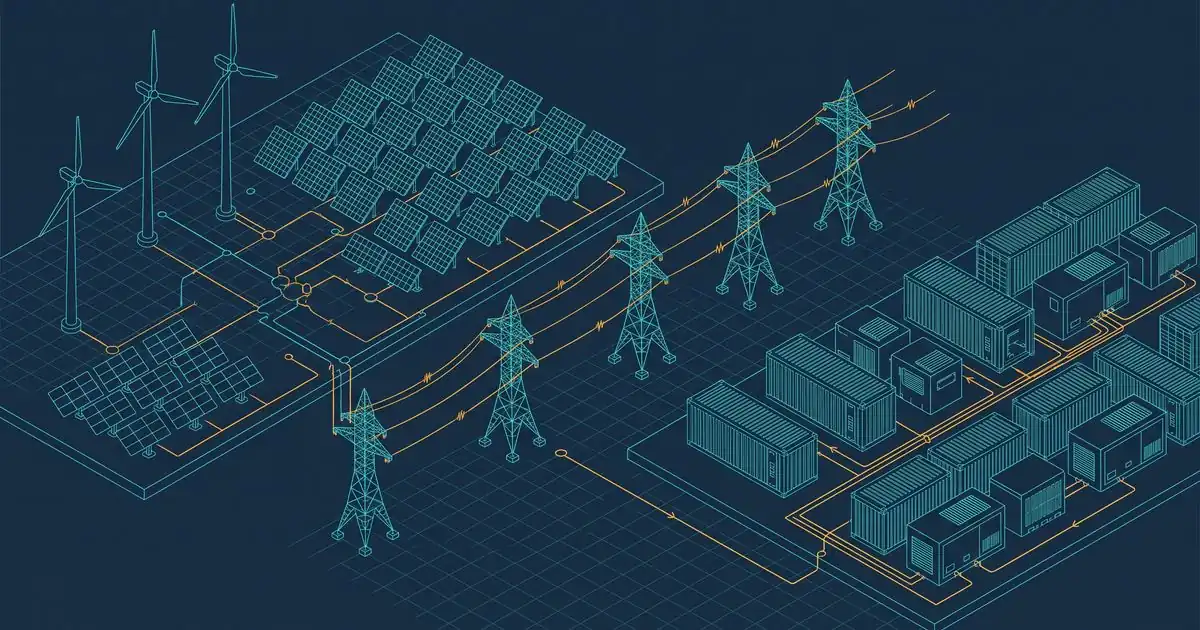
The renewables dilemma: why solar and wind are not enough on their own
Technology companies were pioneers in sustainability targets, contracting large volumes of solar and wind power over the last decade. For cutting-edge AI, however, those sources face a physical obstacle that cannot be crossed: intermittency.
Training a frontier model brings together tens of thousands of GPUs interconnected by very-high-speed links (InfiniBand or 800 Gbps Ethernet networks). That parallel computation operates as a single organism: if the power fluctuates or drops out for fractions of a second in one of the campus buildings, the entire cluster can interrupt the cycle, corrupt checkpoints, and waste hours or days of extremely expensive computation.
AI computing needs continuous, predictable baseload (firm baseload): exactly the same number of megawatts, second by second, 24 hours a day, 365 days a year.
- Solar power: peaks at noon and falls to zero at night.
- Wind power: fluctuates with the seasons and weather fronts.
- Lithium batteries: cover the fast 4-hour peak to shift solar energy into the early evening, but they do not have the economic capacity to hold a 500-megawatt data center through two or three days of calm and overcast weather.
- The power-transmission queue: in the United States and in Europe, the time to connect a new large solar or wind plant to the regional transmission grid (such as the PJM grid operator) ranges from 5 to 7 years, because of bureaucratic slowness and the overload on existing lines.
It is at that bottleneck that nuclear power reappears as the only existing alternative capable of supplying gigawatts of clean, carbon-free energy with no hourly fluctuation.
The nuclear return: Three Mile Island, SMR reactors, and direct purchases
In less than a year, the world’s largest buyers of computing announced bold moves on the global energy board:
1. Microsoft and the restart of Three Mile Island
In September 2024, the utility Constellation Energy announced a 20-year power purchase agreement (PPA) with Microsoft. The agreement made it possible to reopen Unit 1 of the Three Mile Island nuclear plant in Pennsylvania — renamed the Crane Clean Energy Center.
The unit, which had been shut down in 2019 for purely economic reasons (when fossil natural gas was excessively cheap), will receive billions of dollars in private investment to reconnect its generators by 2027/2028, injecting 835 megawatts of firm, zero-carbon energy exclusively for Microsoft’s cloud.
2. Google and Small Modular Reactors (SMRs) with Kairos Power
In October 2024, Google signed the first commercial agreement of its kind with the nuclear startup Kairos Power. Instead of depending on gigantic traditional nuclear plants, the partnership aims to order a fleet of Small Modular Reactors (SMRs) totaling up to 500 MW by 2035.
SMRs are reactors built in a modular factory environment and transported by train or truck to the installation site. They use innovative technologies — such as passive cooling with molten salt at high temperature and low pressure — eliminating the loss-of-coolant risks typical of older pressurized-water plants and allowing decentralized installation.
3. Amazon Web Services and the Susquehanna plant
Amazon (AWS) acquired, for 650 million dollars, a data-center campus of up to 1,920 MW developed by Talen Energy, located physically next to the Susquehanna nuclear plant in Pennsylvania.
The model is what is called behind-the-meter: the data center receives energy directly from the plant’s nuclear generators before it enters the public transmission grid, bypassing the connection waiting lines of the regional utilities.
What this means for the future of technology and for people
That forced convergence between advanced computing and heavy infrastructure brings practical consequences that are already beginning to be felt:
1. Pressure on local rates and competition for space on the grid
Where new data centers are installed in large numbers (as in the state of Virginia or in Pennsylvania, in the United States), local governments and consumer-advocacy bodies are already discussing who will bear the cost of expanding the power grids. If large companies reserve entire plants for their servers, the surplus electricity for industry and homes can become more expensive or scarce.
2. The forced economic incentive for more efficient models
Until recently, developers could ignore the efficiency of code and infrastructure: if a model was too heavy, it was enough to rent more cards in the cloud. With the megawatt costing a lot and the capacity for physical expansion locked by the power grid, the focus necessarily moved to algorithmic efficiency:
- The advance of SLMs (Small Language Models), which solve specific problems with a fraction of the energy use.
- Aggressive quantization techniques (such as INT4 and compact formats), which reduce data movement and the chip’s electrical effort.
- Running everyday tasks at the edge (Edge AI and local NPUs), sparing unnecessary trips to the cloud.
3. The end of the “ethereal cloud” myth
The idea that the internet and algorithms live in an abstract, intangible virtual space has evaporated for good. Cutting-edge artificial intelligence is one of the most physically heavy technologies engineering has ever built: it requires tons of copper, purified water, integrated circuits of pure silicon, and nuclear turbines spinning at thousands of revolutions per minute.
Anyone who works with technology today needs to understand that the next barrier to innovation will not be decided only in lines of Python or in transformer architectures, but in how many transmission lines and clean gigawatts we manage to put in place safely. How those lines are operated day to day appears in the post about the management system of a transmission operations center. In Brazil, the immediate limit is usually a different one: the queue and the connection margin on the Basic Network, even before the GPU shelf.
Sources cited and official references
- International Energy Agency (AIE / IEA): Electricity 2024 – Analysis and forecast to 2026 (Official report on global electricity demand and the impact of data centers and AI).
- Constellation Energy: Official announcement of the Crane Clean Energy Center and the 20-year supply agreement with Microsoft (September 2024).
- Google Blog & Kairos Power: Accelerating clean energy with Kairos Power SMRs – Partnership to supply 500 MW of advanced nuclear energy (October 2024).
- Talen Energy / AWS: Regulatory filings with the SEC on the acquisition and expansion of the Cumulus Data Center campus at the Susquehanna nuclear plant (2024–2025).
- NVIDIA Corporation: Technical architecture and thermal/electrical specifications of Blackwell AI systems and NVL72 liquid-cooling platforms (2024–2025).