
In our November 11, 2026 breakdown of Gemini 4 Carbon for agent swarms, we simulated how parallel coordination tends to outperform single-model chat loops on long engineering workflows. The other half of that comparison arrived one day before Google’s broader rollout: on November 9, 2026, Anthropic shipped Claude Fable 5.2 (claude-fable-5-2) alongside its restricted defensive counterpart, Claude Mythos 5.2. On the November rate card alone, Fable 5.2 lists at four times Carbon’s promotional pricing ($8.00 / $40.00 versus $2.00 / $10.00 per million tokens).
Bottom line first: once promotional end dates, per-provider cache mechanics, and mandatory thinking overhead enter the math, three rules settle swarm routing:
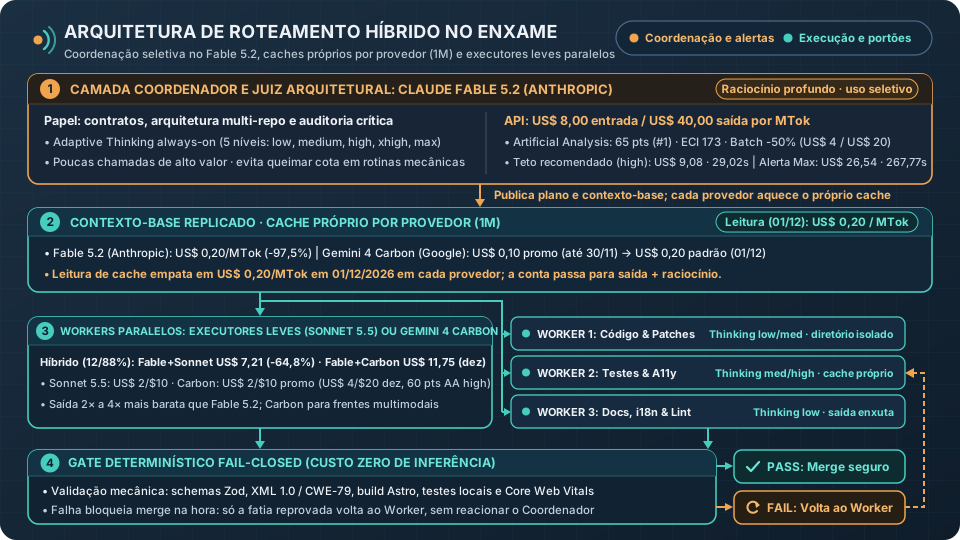
- Cache-read parity on December 1, 2026: when Carbon’s promo expires, reading cached context costs $0.20 per million tokens on both models, each inside its own separate provider cache.
- Max effort nearly triples per-task spend: in Artificial Analysis telemetry, stepping Fable 5.2 from
hightomaxadds 3 index points (62 to 65), yet lifts average task cost from $9.08 to $26.54 and stretches wait time before the first answer token from 29.02s to 267.77s. - Where hybrid routing actually saves money: the lowest-cost swarm rarely puts the frontier model on 100% of calls; it keeps Fable 5.2 at the top for planning and critical review while routing parallel execution to flat-rate lightweight workers (such as Sonnet 5.5, -64.8% post-December), using Carbon as worker mainly for native multimodality or during November’s promo window.
This piece is a structured comparative study grounded in primary technical documentation, active pricing schedules, and independent benchmarks verified on November 12, 2026. We did not run our own benchmarks on Claude Fable 5.2; every cost simulation below applies reproducible arithmetic directly to official API rates and to the aggregate baselines published in our archive, with analytical assumptions declared before each calculation.
Crossing billing schedules, per-provider cache isolation, and output-token multipliers explains why list rates mislead swarm architects.
What Changes on the Spec Sheet and Where the Rate Card Misleads
Anthropic positioned Claude Fable 5.2 with a 20% list-price reduction compared to Fable 5.1 ($10 / $50 down to $8 / $40), backed by a 1-million-token context window, a 128K-token output cap, and a June 2026 knowledge cutoff. Yet just as we documented when examining nominal price cuts versus tokenizer inflation, lower per-token rates do not automatically shrink task invoices.
On Fable 5.2, Adaptive Thinking is always active and cannot be switched off via the API. Callers steer reasoning depth through the effort parameter across five tiers (low, medium, high, xhigh, and max), defaulting to high on API requests and medium inside Claude Code and Claude apps. Requests that attempt to force tool selection (tool_choice set to any or tool) or set temperature, top_p, or top_k return an HTTP 400 error, which requires refactoring legacy workflows built around strict request-level sampling flags.
| Technical or Commercial Dimension | Claude Fable 5.2 (Anthropic) | Gemini 4 Carbon (Google DeepMind) |
|---|---|---|
| General Release | 2026-11-09 (with restricted Mythos 5.2) | Fairwind preview 2026-10-28; GA 2026-11-10 |
| Context Window / Max Output | 1M input / 128K output tokens | 1M input; multimodal (text, image, audio, video) |
| Reasoning Control | Always-on Adaptive Thinking (low to max) | Explicit Thinking Levels (low, medium, high) |
| Standard Input / Output (MTok) | $8.00 / $40.00 | $2.00 / $10.00 through 11/30; $4.00 / $20.00 starting 12/01 |
| Prompt Cache Read (MTok) | $0.20 (97.5% off) with paid explicit write | $0.10 through 11/30; $0.20 starting 12/01 (95% off, implicit only) |
| Prompt Cache Write (MTok) | $10.00 (5m TTL) or $16.00 (1h TTL) | No separate write fee (automatic implicit caching) |
| Batch and Speed Tiers | Batch -50% ($4 / $20); Fast Mode $16 / $80 (2x) | Batch -50% ($1 / $5 through 11/30; $2 / $10 starting 12/01) |
| Artificial Analysis Index (Indep.) | 65 (max) and 62 (high) | 60 (high) |
| Epoch Capabilities Index (Indep.) | 173 (#1 of 240 tracked models) | 170 (#2) |
| Immediate Multi-Cloud GA | Claude API, Bedrock, Vertex AI, Microsoft Foundry | Google Gemini API / AI Studio (no Free tier) |
Google AI Studio’s official pricing documentation includes an architectural constraint easily missed in quick summaries: Gemini 4 Carbon supports implicit context caching only (explicit TTL cache pinning is not supported). By contrast, Anthropic bills an explicit write surcharge on Fable 5.2 ($10.00/MTok for a 5-minute TTL or $16.00/MTok for 1 hour) and pairs it with guaranteed cache reads at $0.20/MTok, a 97.5% discount off base input. In multi-agent workflows where dozens of worker calls hit an identical repository snapshot or contract spec within a fixed window, deterministic prefix pinning protects hit rates against minor prompt-order drift.
December Cache Convergence and Reproducible Swarm Math
The first pricing surprise comes straight from Google’s billing calendar. Carbon’s introductory rates ($2.00 input, $10.00 output, $0.10 cache read) expire on November 30, 2026. Starting December 1, 2026, standard paid tiers move to $4.00 input, $20.00 output, and $0.20 context caching.
At that point, Carbon’s unit advantage on repeated context reads disappears. Note carefully that prompt caching remains strictly isolated per provider and per model: a cross-vendor swarm shares no cache memory between Anthropic and Google, so each provider warms and pays for its own copy of the replicated base context. What ties at $0.20 per million tokens starting in December is the cache-read rate inside each provider’s own cache.
Any remaining bill divergence shifts to three variables: cold cache writes ($10/MTok explicit on Fable 5.2 versus implicit caching on Carbon), uncached fresh input ($8 versus $4), and especially output plus internal thinking tokens ($40/MTok versus $20/MTok, since both vendors bill reasoning tokens at the output rate).
To measure practical impact, we apply the aggregate envelopes from two earlier scenarios on this site using explicit analytical assumptions for uniform comparison. First, take the 300,000-token codebase across 5 agents and 10 iterations from our November 11, 2026 Gemini 4 Carbon post. Because that post did not publish per-turn token splits, we adopt a uniform assumption of 50 calls priming 300K tokens once, reading 14.7M cached tokens, adding 25K fresh instruction tokens, and generating 100K output tokens with moderate reasoning:
- Gemini 4 Carbon in November ($2 / $10 / $0.10 cache): assuming full implicit cache hits across the 14.7M read tokens, total spend is
(0.325 * 2.00) + (14.7 * 0.10) + (0.100 * 10.00)= $3.12. In the November 11 post, the figure cited below $1.50 matches the isolated cache-read component alone (14.7M at $0.10/MTok = $1.47); adding initial uncached input ($0.65, bringing total input to $2.12) plus output ($1.00) yields the full $3.12 bill. - Gemini 4 Carbon starting December 1 ($4 / $20 / $0.20 cache): under identical assumptions, the bill doubles to
(0.325 * 4.00) + (14.7 * 0.20) + (0.100 * 20.00)= $6.24. - Claude Fable 5.2 ($8 / $40 / $10 5m write / $0.20 read): 0.300M explicit write ($3.00) + 0.025M fresh input ($0.20) + 14.7M cache read ($2.94) + 0.100M output ($4.00) = $10.14. Under the controlled premise of matching output volume, pushing deliberation from 100K to 500K tokens takes Fable 5.2 to $26.14, versus $14.24 on Carbon in December.
Second, we project these rates onto the 6.67-million-token envelope from our real multi-agent cycle audit. Because that audit logged total tokens without storing call-type splits, we model an illustrative cache-heavy breakdown (5.80M cache-read tokens, 0.50M uncached input and cache-write blended at $9.00/MTok on Fable, and 0.37M output plus reasoning tokens) alongside an illustrative 12% coordinator / 88% worker split. Output volume is held identical by construction; if Carbon repeated the 2.4x higher output verbosity measured on Artificial Analysis (roughly 0.888M output tokens), its post-December invoice would climb to around $20.92 ($1.16 + $2.00 + $17.76), virtually tying an all-Fable swarm ($20.46):
| Topology on an Illustrative 6.67M-Token Cycle | Cache + Fresh Input | Output + Reasoning | Estimated Total Cost |
|---|---|---|---|
| 100% Claude Fable 5.2 Swarm | $1.16 cache + $4.50 fresh/write | 0.37M * $40.00 = $14.80 | $20.46 ($35.26 if output doubles) |
| 100% Gemini 4 Carbon (Post-Dec 1) | $1.16 cache + $2.00 fresh | 0.37M * $20.00 = $7.40 | $10.56 ($5.28 through Nov 30) |
| Cost-Optimal Hybrid (12% Fable + 88% Sonnet 5.5) | Fable $0.68 + Sonnet $1.50 | Fable $1.78 + Sonnet $3.26 | $7.21 (-64.8% vs. all-Fable) |
| Cross-Vendor Hybrid (12% Fable + 88% Carbon) | Fable $0.68 + Carbon $2.78 | Fable $1.78 + Carbon $6.51 | $11.75 post-Dec 1 ($7.10 in Nov.) |
This split illustrates Anthropic’s Orchestrator (decomposition and delegation) and Advisor (escalation on stuck steps) patterns, assigning 12% to Fable 5.2 (0.696M cache read, 0.060M blended fresh/write at $9.00/MTok, 0.0444M output = $2.46) and 88% to the worker model:
- Lowest-cost post-December route (12% Fable 5.2 + 88% Claude Sonnet 5.5): applying symmetric 5-minute cache writes to Sonnet 5.5’s published rates (5.104M cache read at $0.10/MTok, 0.440M blended at $2.25/MTok between $2.00 and $2.50, and 0.3256M output at $10.00/MTok = $4.76) gives $7.21 before intermediate rounding, cutting spend by 64.8% (roughly 65%) versus an all-Fable swarm because Sonnet 5.5’s rates do not double on December 1.
- Cross-vendor route with Gemini 4 Carbon (12% Fable 5.2 + 88% Carbon, synchronous calls): during November’s promo ($2 / $10), Carbon workers cost $4.65 for a $7.10 cycle total; starting December 1 ($4 / $20), Carbon workers jump to $9.29 and the pair reaches $11.75, above synchronous all-Carbon at $10.56.
- When pairing with Carbon makes sense and the Batch API effect: on a symmetric sync comparison, this cross-vendor hybrid justifies its cost through multi-cloud resilience, native worker multimodality, or coordinator ceiling rather than raw savings. Moving the 88% worker share to Carbon’s Batch API ($2 / $10 and $0.10 cache read starting December 1, per Google AI Studio’s Batch pricing tab) brings that share to $4.65 for a $7.10 total: below synchronous all-Carbon ($10.56), yet above all-Carbon run in Batch ($5.28).
The Five Effort Tiers, Answer Latency, and Max-Effort Risk
Unit token prices still leave out the operational bottleneck catching teams off guard since November 9: internal deliberation scaling with effort. Fable 5.2’s five effort tiers are not a hard token cap. As Anthropic’s API docs explicitly state, effort is a behavioral signal rather than a strict token budget, meaning the model still spends extra thinking tokens on hard prompts even below max.
Independent telemetry published by Artificial Analysis (Intelligence Index v5.0.1, verified November 12, 2026) quantifies the marginal cost of each tier alongside Gemini 4 Carbon at high effort:
| Measured Configuration (Artificial Analysis v5.0.1) | Intelligence Index | Time to First Answer Token | Output Speed | Time per Task | Avg. Cost per Task | Index Output Tokens |
|---|---|---|---|---|---|---|
Claude Fable 5.2 (low) | 54 (#15) | 8.45s | 98 tok/s | 6.1 min | $3.10 | 34.9M |
Claude Fable 5.2 (medium) | 56 (#9) | 11.67s | 95 tok/s | 7.6 min | $3.80 | 41M |
Claude Fable 5.2 (high, API default) | 62 (#3) | 29.02s | 97 tok/s | 16.9 min | $9.08 | 85.3M |
Claude Fable 5.2 (xhigh) | 62 (#2) | 87.90s | 103 tok/s | 26.2 min | $14.83 | 144M |
Claude Fable 5.2 (max) | 65 (#1) | 267.77s | 98 tok/s | 46.8 min | $26.54 | 275M |
Gemini 4 Carbon (high) | 60 (#4) | 67.62s | 75 tok/s | 27.4 min | $5.48 | 205M |
One measurement nuance is critical when reading column three. The 267.77 seconds (nearly four and a half minutes) measured on Fable 5.2 at max tracks Time to First Answer Token following silent internal reasoning, not initial network handshake latency. Once answer streaming begins, generation stays brisk (95 to 103 tok/s versus Carbon’s 75 tok/s), yet max forces downstream callers or human engineers to sit through minutes of hidden deliberation before seeing token one.
That diminishing-returns slope explains why high (62 points, 29.02s, $9.08) and xhigh (62 points, 87.90s, $14.83) form the practical ceiling for production engineering. Moving from high to max adds just 3 points on the aggregate index (62 to 65), yet increases average task cost by 2.92x ($9.08 to $26.54) and stretches time to first visible answer token by 9.2x. For asynchronous runs, the Batch API cuts input and output rates by half ($4.00 / $20.00), whereas Fast Mode doubles standard pricing ($16.00 / $80.00) for up to 2.5x faster token output, a trade-off worth paying only on human-in-the-loop blockers, never inside autonomous worker loops.
In day-to-day agent orchestration, leaving workers at max with unconstrained reasoning spend amplifies output verbosity (275M output tokens across the Artificial Analysis index versus a 72.8M median among comparable models) and raises the risk of broader edits than a task requires. Because effort sets no hard spending ceiling, containing scope requires the same deterministic harness gates used to govern stochastic outputs: strict allowed-path locks per task, explicit max_tokens limits, and fail-closed schema validation before merging changes.
Benchmark Asymmetry and What Independent Evals Confirm
An honest comparison must highlight the methodological gap between Google’s and Anthropic’s release scorecards. Our November 11, 2026 Carbon breakdown summarized Google’s cited evaluations (SWE-bench Verified at 52.8%, CursorBench at 78.4%, and Zapier AutomationBench at 86.2%), while Anthropic’s November 9 release centered on a newer set of internal and external suites.
In benchmarks reported by Anthropic (2026-11-09), Fable 5.2 reached 69.9% on FrontierSWE v2 (versus 61.2% attributed to Carbon and 62.3% to Opus 5.5), 89.3% on OSWorld 2.1 (versus 81.5% for Carbon), and 74.6% on Terminal-Bench-Science 0.1 (75.3% for Mythos 5.2, versus 64.8% for Carbon). On FrontierCode 2.0, Anthropic’s own comparison table discloses a key settings difference: Fable 5.2 posted 49.1% at Xhigh effort, whereas Gemini 4 Carbon is listed at 41.1% running at Medium effort. Meanwhile, on AutomationBench, Anthropic’s table actually puts Gemini 4 Carbon ahead (53.9% versus 51.4% for Fable 5.2).
Without one unified third-party harness executing every coding suite under equal token and effort budgets, vendor tables serve strictly as directional signals. Turning to the two shared independent benchmarks verified on November 12 narrows the range considerably: on Epoch AI’s ECI, Fable 5.2 leads 240 tracked models at 173 (#1) over Gemini 4 Carbon at 170 (#2); on Artificial Analysis v5.0.1, Fable 5.2 scores 65 at max (#1) and 62 at high (#3) against Carbon’s 60 (#4), with Carbon listed at $5.48 per task (alongside the $2 / $10 November promotional table displayed on the benchmark page) compared to $9.08 for Fable 5.2 at high. Note also that neither provider publicly disclosed parameter counts, internal architecture (dense versus sparse MoE), or training compute.
That per-task picture flips once we check the post-December 1, 2026 break-even equation. Because cache reads tie at $0.20/MTok (canceling that term) and Fable 5.2’s explicit 5-minute write ($10/MTok) sits $6/MTok above Carbon’s equivalent first-pass input ($4/MTok), the USD cost delta reduces to Δ = 4·M_fresh + 6·M_write + 20·M_output, where each M denotes millions of tokens (for fresh input, explicit 5-minute cache write, and output, respectively). When output dominates the bill, as in the Artificial Analysis suite, and input volumes match, Fable 5.2 breaks even whenever it completes the job using roughly half of Carbon’s output tokens. In Artificial Analysis v5.0.1 telemetry, Carbon emitted 205 million output tokens, or 2.4x the 85.3 million spent by Fable 5.2 at high; as an estimate assuming linear scaling with the December 1 standard rate card ($4 / $20), Carbon’s calculated per-task cost doubles to roughly $10.96, higher than Fable 5.2 at high ($9.08).
Multi-Cloud Availability, Data Retention (ZDR), and Fable vs. Mythos
From an enterprise procurement standpoint, Fable 5.2’s biggest practical advantage in November 2026 is not a narrow benchmark edge, but day-one general availability across major cloud providers. claude-fable-5-2 launched immediately across Anthropic’s direct API, Amazon Bedrock (global.anthropic.claude-fable-5-2), Google Cloud Vertex AI (both Google-managed and Anthropic-managed), and Microsoft Foundry. Whereas Gemini 4 Carbon centers its documented API pricing inside Google’s paid tier (Google AI Studio / Gemini API, with no Free tier), organizations already committed to AWS or Azure spend can deploy Fable 5.2 on Bedrock and Microsoft Foundry under existing enterprise agreements right away.
The launch also recalls Google’s closed Fairwind program, discussed on November 11, 2026, under which Carbon was matured for cybersecurity; on Anthropic’s side, splitting the exact same underlying weights into two commercial safeguard regimes is documented in its announcement and system card. Anthropic released Claude Fable 5.2 broadly with layered cyber and biology classifiers, activation probes, strengthened anti-distillation controls (including mandatory preserved thinking to block retroactive editing of reasoning blocks), and transparent fallback to Opus 4.8 (cybersecurity) or Opus 5 (biology) whenever a request trips safety blocks. Meanwhile, Claude Mythos 5.2 exposes those identical weights without specialized cyber/bio blocks exclusively to vetted members of Anthropic’s Cyber Verification Program and Life Sciences Verification Program.
For enterprise security and IDE governance teams, the critical fine print sits in Anthropic’s model-specific retention policy. By default, for any account lacking an express Zero Data Retention (ZDR) exception or Enterprise Frontier Safeguards enrollment, claude-fable-5-2 enforces 30-day data retention for multi-request safety monitoring and is not eligible for ZDR (Enterprise Frontier Safeguards is a private-beta architecture running automated safety checks inside the customer’s own storage perimeter). Administrators enforcing strict ZDR or privacy modes in cloud proxies and editors must confirm contractual exemption before turning Fable 5.2 on across engineering orgs.
Production Decision Matrix
Choosing between Claude Fable 5.2 and Gemini 4 Carbon comes down to where your swarm hits its primary constraint:
- Claude Fable 5.2 (
highorxhigh) fits as coordinator or architectural reviewer when operations require immediate multi-cloud GA across Bedrock, Vertex AI, or Foundry, explicit cache pinning with $0.20/MTok reads, and top-tier reasoning on complex multi-repo refactors. - Claude Sonnet 5.5 ($2 / $10) acts as a candidate default worker (with cache reads documented at $0.10/MTok), subject to validating capability on your workload after December 1 ($7.21 in the illustrative hybrid simulation inside the same Anthropic cache boundary), whereas Gemini 4 Carbon (
mediumorhigh) suits multimodal loops and security hardening on Google AI Studio / Gemini API’s paid tier, capturing November promotional savings or strong workflow execution (53.9% on AutomationBench). - Max effort and Fable 5.2 belong outside repetitive execution loops unless protected by strict harness budgets and directory locks. Routine subtasks resolve on lower-cost tiers such as Opus 5.5 ($4 / $20), Sonnet 5.5 ($2 / $10), or Haiku 5.5 ($0.10 / $0.50 up to 100K input tokens), avoiding four-minute deliberation stalls on mechanical edits.
Cross-vendor hybrids combining Fable 5.2 and Carbon route source code through two separate external data processors (Anthropic and Google’s paid tier), requiring ZDR and data-handling validation across both agreements; because forced tool_choice throws an HTTP 400 on Fable 5.2, deterministic gates must verify structured output schemas post-response instead of relying on call-level tool locking.
In production agent swarms, the priciest frontier model never pays for itself by replacing cheaper models; it earns its rate card by thinking sparingly at the top of the graph so dozens of low-cost workers do not scale the wrong plan.
Sources
- Claude Platform Docs — Claude Fable 5.2 Overview & Effort (
2026-11-09, verified2026-11-12):1Mcontext,128Kmax output,effortlevels as behavioral signals,400errors on sampling/forced tool choice, 30-day retention, ZDR restrictions, and cloud IDs. platform.claude.com/docs/en/models/fable-5-2/overview and platform.claude.com/docs/en/build-with-claude/effort - Claude Platform Docs — Pricing (
2026-11-09, verified2026-11-12): standard input/output rates, prompt cache write/read pricing, Batch API (50%off), and Fast Mode rates across Fable 5.2, Opus 5.5, Sonnet 5.5, and Haiku 5.5. platform.claude.com/docs/en/about-claude/pricing - Anthropic — Introducing Claude Fable 5.2 and Claude Mythos 5.2 (
2026-11-09, updated2026-11-11, verified2026-11-12): release announcement, vendor-reported benchmarks (FrontierCode 2.0, FrontierSWE v2, AutomationBench, OSWorld 2.1, Terminal-Bench-Science 0.1), Advisor/Orchestrator patterns, Opus 4.8 / Opus 5 fallbacks, Enterprise Frontier Safeguards, and verification programs. anthropic.com/claude-fable-and-mythos-5-2 - Anthropic — Claude Fable 5.2 and Claude Mythos 5.2 System Card (
2026-11-09, verified2026-11-12): safety evaluations, safeguards architecture, and shared-weights governance. anthropic.com/document/claude-fable-5-2-mythos-5-2-system-card - AWS — Claude Fable 5.2 is now available on AWS (
2026-11-09, verified2026-11-12): Amazon Bedrock general availability (global.anthropic.claude-fable-5-2). aws.amazon.com/about-aws/whats-new/2026/11/claude-fable-5-2-aws/ - Google AI Studio — Gemini API Pricing: Gemini 4 Carbon (
2026-11-10, verified2026-11-12): November promotional pricing ($2 / $10,$0.10cache), December 1 schedule ($4 / $20,$0.20cache), and implicit-only caching specification. aistudio.google.com/docs/pricing - Artificial Analysis — Claude Fable 5.2 (
max,xhigh,high,medium,low) & Gemini 4 Carbon (high) (2026-11-12): independent Intelligence Index v5.0.1 scores, Time to First Answer Token, output speed, task duration, and cost per task. artificialanalysis.ai/models/claude-fable-5-2 and artificialanalysis.ai/models/gemini-4-carbon - Epoch AI — Claude Fable 5.2 & Gemini 4 Carbon (Epoch Capabilities Index) (
2026-11-09, verified2026-11-12): independent ECI rankings (173vs.170) and undisclosed training parameter/compute records. epoch.ai/models/claude-fable-5-2 and epoch.ai/models/gemini-4-carbon