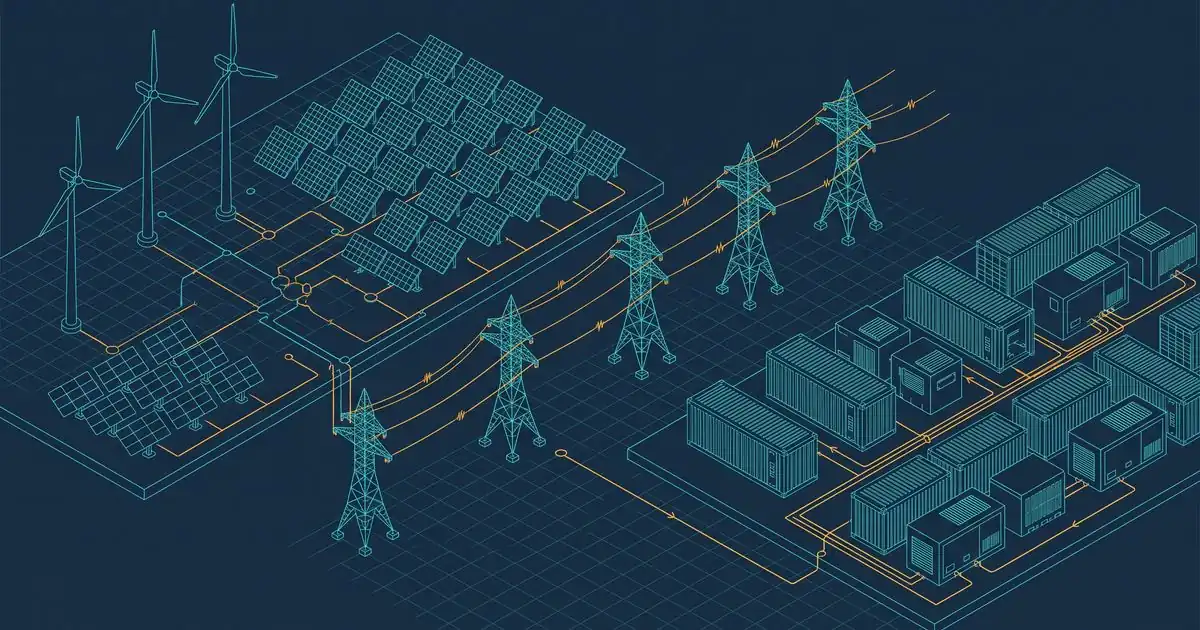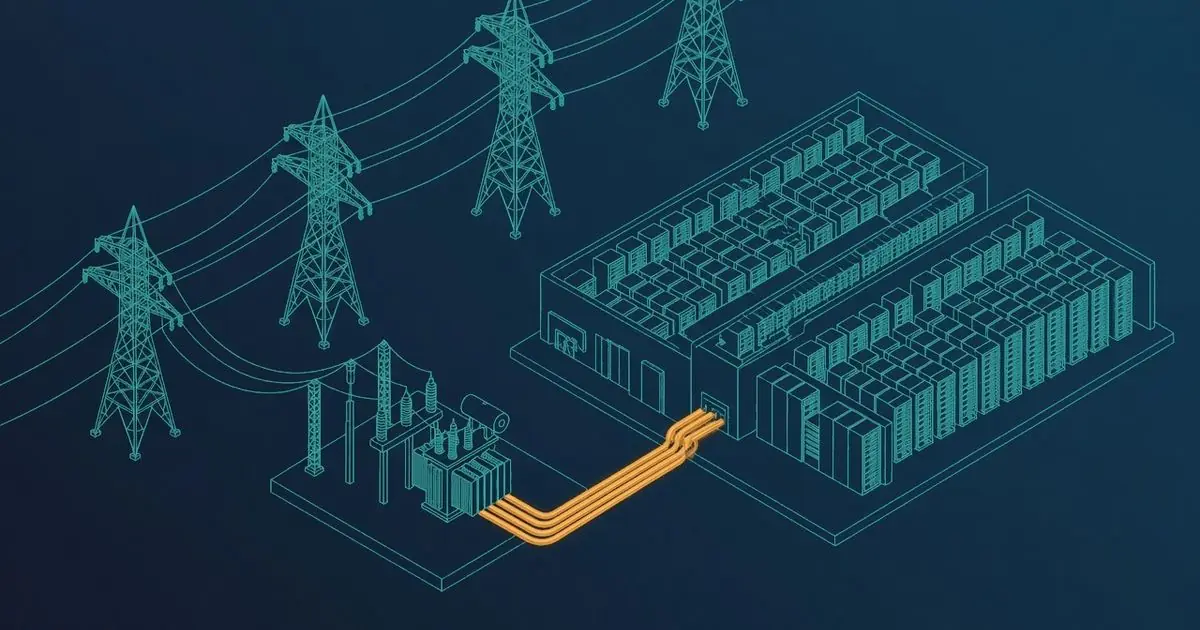
In Brazil, the immediate limit on large-scale artificial-intelligence campuses is rarely a lack of chips on the shelf. It is the connection margin on the Basic Network: the physical and contractual point at which a load of tens or hundreds of megawatts can be connected to the National Interconnected System (SIN) without violating transmission limits. The GPU matters, and it matters a great deal. But the queue that sets the calendar for an AI data center in the country passes, first, through the National Electric System Operator (ONS), the Energy Research Company (EPE), and the transmission reinforcements that take years to get off paper.
This post is an analysis of public sources. It complements the global reading of AI’s electric wall with the Brazilian angle on transmission. The aim is to state the thesis, show the evidence, open the counterpoint, declare the limits, and leave a method for reading the numbers without turning them into a headline.
The thesis: the structural bottleneck is the connection, not the GPU shelf
Generation in Brazil remains abundant at national scale. What constrains the deployment of high-consumption data centers is the remaining capacity on the right buses, at the right moment, under reliability criteria. Study and access requests grew at the pace of a commercial announcement; transmission works and the release of margin follow the pace of sector planning.
The time gap reinforces the thesis. In July 2026 coverage, Valor Econômico recorded the comparison current in the sector: a data center can be built in about a year and a half to two years, while a transmission project usually takes about seven years to delivery. While the GPU changes generation in short cycles, the substation and the high-voltage corridor change in cycles of auction, licensing, and construction.
That is why a serious conversation about AI in Brazil has to separate three layers that the press and official statements mix with ease:
- Declared interest — megawatts in a study request or an access-opinion request.
- A connection right at maturity — a favorable opinion, a transmission-use contract, a financial guarantee.
- Load that enters operational planning — average megawatts that EPE, the ONS, and the Electric Energy Commercialization Chamber (CCEE) accept projecting over the horizon of the Annual Energy Operation Planning (PLAN).
Confusing the first layer with the third turns a queue into capacity. That is exactly the error this analysis tries to close.
What the Basic Network decides in practice
The Basic Network is the SIN’s transmission trunk: the high-voltage lines and substations that carry energy between regions and to the large load centers. A traditional cloud data center can, in some cases, connect at distribution voltage. An AI campus with tens or hundreds of megawatts tends to request a direct connection to the Basic Network, because the power density and the continuity required exceed what the local network absorbs without reinforcement.
Imagine, for example, that a developer has land, fiber, and GPUs reserved in a city in the interior of São Paulo. Without margin on the target bus, the campus does not energize the full load. Without an opinion and a contract, financing treats energy as an open risk. Without a transmission reinforcement on the planning horizon, the commercial calendar pulls away from the electrical calendar.
Operating and planning that network does not mean merely adding up announced megawatts. It means interpreting loading, short circuit, reliability criteria, and the order in which new loads fit without degrading existing service. Anyone who lives transmission operations already recognizes the problem under another name: margin, contingency, and the access queue. The AI race only made the same object more visible outside the electricity sector.
Evidence 1 — the explosion of requests is not installed capacity
In a November 2025 note, EPE recorded the jump in data-center projects with a minimum-global-cost study request filed at the Ministry of Mines and Energy (MME) for connection to the Basic Network: from 19.8 GW in September 2025 to 26.2 GW in November of the same year, an addition of 6.4 GW in about 60 days after the REDATA provisional measure. EPE itself warns, in the same text, that turning the projects into reality depends on transmission, telecommunications, economic and financial viability, and the new guarantee rules.
An EPE technical article (GPL-018) shows the acceleration even earlier in the historical series: in June 2024, PDE 2034 mapped about 2.5 GW in 12 projects through 2037; with data updated through February 2025, the set jumped to about 15.7 GW in 36 projects. In June 2026, the minister of Mines and Energy cited 38 GW in access-opinion requests for data centers, of which 7.1 GW were at a more advanced stage, associated with estimated investments of R$159 billion — numbers echoed by BNamericas and by the eixos portal from the official remarks.
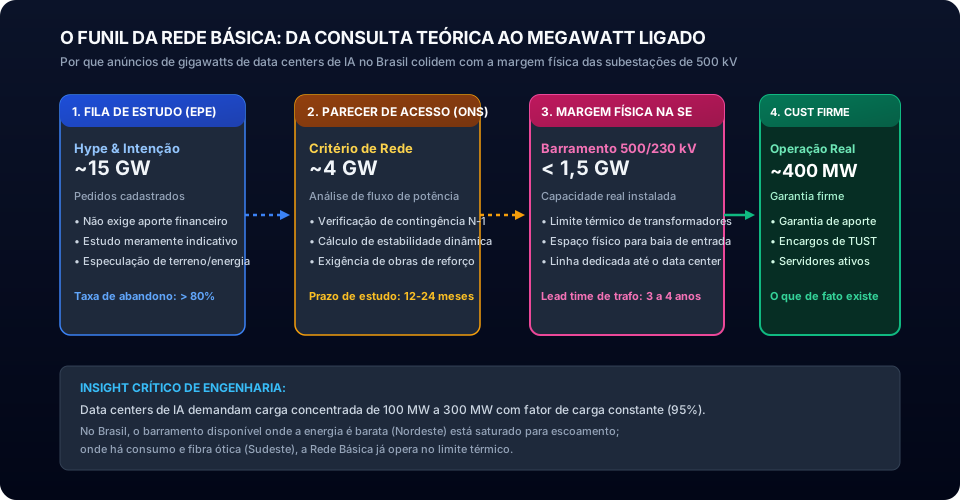
An honest reading of these numbers starts with a sentence the headline almost never carries: a request is not a connected data center. It is a declaration of interest under a regulatory rite. Part of the queue never pays the guarantee, part does not obtain margin, and part is delayed or migrates its connection point.
Evidence 2 — the ONS filter and the first Access Season
Decree No. 12,772, of December 5, 2025, established the National Policy for Access to the Transmission System (PNAST). Instead of a purely chronological queue, permanent access to the Basic Network is organized into Access Seasons: windows in which the ONS analyzes demands in a block and, where demand exceeds available capacity, runs a competitive process.
In February 2026, DatacenterDynamics (DCD) reported the policy’s first concrete filter: of 94 proceedings moving through the MME, 39 were formalized at the ONS with a Financial Guarantee for an Access Request, resulting in 43 requests. About 41% of the initial projects met the requirements to enter that stage. Of the 43 formalized accesses, 38 were data centers, totaling approximately 7,040 MW of requested load; São Paulo concentrated 20 requests and about 3,914 MW.
Folha, on June 20, 2026, described the practical effect of the contest: at points where demand exceeds capacity, the connection can slip to after 2030, and the tiebreaker becomes the largest financial bonus per available kilowatt. In the same text, the ONS appeared with 61 requests for direct connection to the Basic Network under review, 38 of them data centers. The institutional message and the commercial message diverge: the announcement sells megawatts; the operator sells remaining margin.
The first Access Season of 2026 confirmed local scarcity even with abundant generation in the country. According to the ONS webinar and technical note on remaining capacity, 20.28 GW were registered on 64 candidate buses: about 8.06 GW with an indication of direct service, 2.94 GW with an indication of a competitive process, and 9.28 GW with no margin in the horizon analyzed. In São Paulo, 1.95 GW of load requests appeared associated with a combined limit on the order of 650 MW at 13 points, in the scenario with planned reinforcements.
The competitive outcome, reported by the eixos portal on October 7, 2026, was even tighter in the first margin auction: three data centers were awarded the 228 MW offered in São Paulo, against 451 MW of qualified demand from seven projects. The GPU may be available on the world market; the 228 MW of margin, in that window, was not.
Evidence 3 — what operational planning actually embeds
The difference between queue and load appears clearly in the 1st Four-Month Review of PLAN 2026–2030, documented by EPE, the ONS, and the CCEE in April 2026. To project data centers, the study considered requests with a signed contract and, with partial weight, requests with a favorable opinion. Requests still “in progress” were left out of the scenario.
The result, in the review’s technical note: an addition of 304 average MW to the 2026 load and of 3,457 average MW to the 2030 load on the SIN. On March 20, 2026, the base the study used recorded 22 requests with a signed contract, 18 with a favorable opinion, and 50 under review. In other words: operational planning works with a filtered fraction of what the press calls a “pipeline.”
This is the number an infrastructure manager should prefer when someone says that “Brazil will have X gigawatts of AI.” Not because the queue is irrelevant — it signals pressure — but because the PLAN states the inclusion criterion. Without a criterion, the gigawatt becomes ornament.
How to read the public numbers without turning them into clickbait
The table below summarizes the method. Each row answers a different question. Mixing them produces energy clickbait.
| Question | Typical indicator | What it proves | What it does not prove |
|---|---|---|---|
| Is there demand pressure? | GW in requests at the MME/ONS | Interest and competition for points | Energized capacity |
| Has the project matured financially? | Guarantee, opinion, use contract | Regulatory commitment | Entering operation on the announced date |
| Does the system already count this load? | Average MW in the PLAN (EPE/ONS/CCEE) | An operational-planning premise | That every request will become a campus |
| Is there physical room at the point? | Remaining capacity per bus | Local margin and the reinforcement horizon | National generation “left over” at the project’s address |
| Who gets the contested margin? | Access Season result / competitive process | Allocation under the rule in force | That the loser “will have no energy in Brazil” |
Three practical rules close the reading:
- Always ask for the date of the snapshot. 2.5 GW (2024), 15.7 GW (Feb. 2025), 26.2 GW (Nov. 2025), and 38 GW (June 2026) are not the same series or the same stage.
- Always ask for the unit. A megawatt of requested power is not an average load megawatt in the PLAN.
- Always ask for the point. São Paulo and Campinas concentrate requests; the Northeast concentrates renewable generation and, on several buses in the season, disqualification for lack of margin for new generators. The map matters more than the national total.
EPE also points to the other side of the ledger: transmission studies in São Paulo have already recommended about R$1.6 billion in investment to unlock about 4 GW of margin, with an expectation of about another 5 GW in works to be auctioned; studies are planned for Rio de Janeiro (on the order of 4 GW), Rio Grande do Sul, and the Northeast. The bottleneck is real. It is not static.
Counterpoint: the GPU still matters — and generation is still an advantage
It would be a mistake to invert the excess and declare that chips and generation no longer matter.
The GPU still defines rack density, cooling architecture, and the flat load profile the campus requires 24 hours a day. Without silicon, there is no load to connect. AI’s electric wall remains valid on the global plane: thermal density, baseload, and firm energy contracts.
In Brazil, a generation mix with a strong hydro share and renewable expansion keeps attracting investors precisely because there is energy to contract. Projects close to generation, use of energy that would be curtailed, and targeted line reinforcements already appear as strategies of those who understood the bottleneck. The curtailment calculation for wind and solar, recomputed from ONS open data, is in Generation curtailment and batteries. The PNAST, for its part, does not “create” megawatts: it organizes the contest and requires financial maturity earlier. For anyone who operates transmission, this looks less like a regulatory miracle and more like queue discipline under local scarcity.
The honest counterpoint, then, is double. Without a GPU and without an energy contract, the campus does not exist. Without margin on the Basic Network at the chosen address, the campus does not energize either. In the Brazil of 2025–2026, the second constraint began to set the calendar more often than the first.
Limits of this analysis
This piece does not estimate how many of the 38 GW will “get off paper.” It also does not assess the quality of each individual opinion, or the corporate viability of the developers. It does not model the energy price, the cost of water cooling, or the full tariff impact of the reinforcements — subjects that Folha and sector specialists already raise and that deserve pieces of their own.
Press numbers (Valor, Folha, DCD, eixos, BNamericas, CanalEnergia) enter here as attributed fact, cross-checked whenever possible with an EPE note, the decree, an ONS page, or a PLAN technical note. When the source is a ministerial remark reproduced by the press, the claim stays attributed. Remaining capacity and season results change with every cycle; the verification of this analysis is November 2, 2026.
There is also a limit of domain. Knowing the queue does not replace knowing the operation: switching, restoration after a contingency, and the discipline of logging at the operations center. On Fluxonar itself, the technical case of SIGCOT and the substation switching simulator illustrate that operational ground; they are not a sales argument in this analysis, only a reminder that the Basic Network is not a statistical abstraction.
Conclusion
I believe the Brazilian debate on AI infrastructure gains more when it trades the total of requests for the inclusion criterion. The public evidence from 2025 and 2026 shows requests in the tens of gigawatts, a hard filter of guarantee and formalization, a local contest for hundreds of megawatts in São Paulo, and an operational projection on the order of 3.5 average GW in 2030 in the PLAN’s filtered scenario. That does not cancel the importance of the GPU. It reorders the question.
The structural bottleneck of AI in Brazil, in this cycle, is not the absence of a chip in the catalog. It is the queue — and, after the PNAST, the season — on the Basic Network: margin, connection point, transmission reinforcement, and contractual maturity. Anyone who can read a request, an opinion, a contract, and an average megawatt as distinct objects will be less exposed to clickbait and closer to the physics and the regulation that actually free or stall a campus.
The GPU speeds up the computation. The Basic Network decides whether the computation has somewhere to plug in.