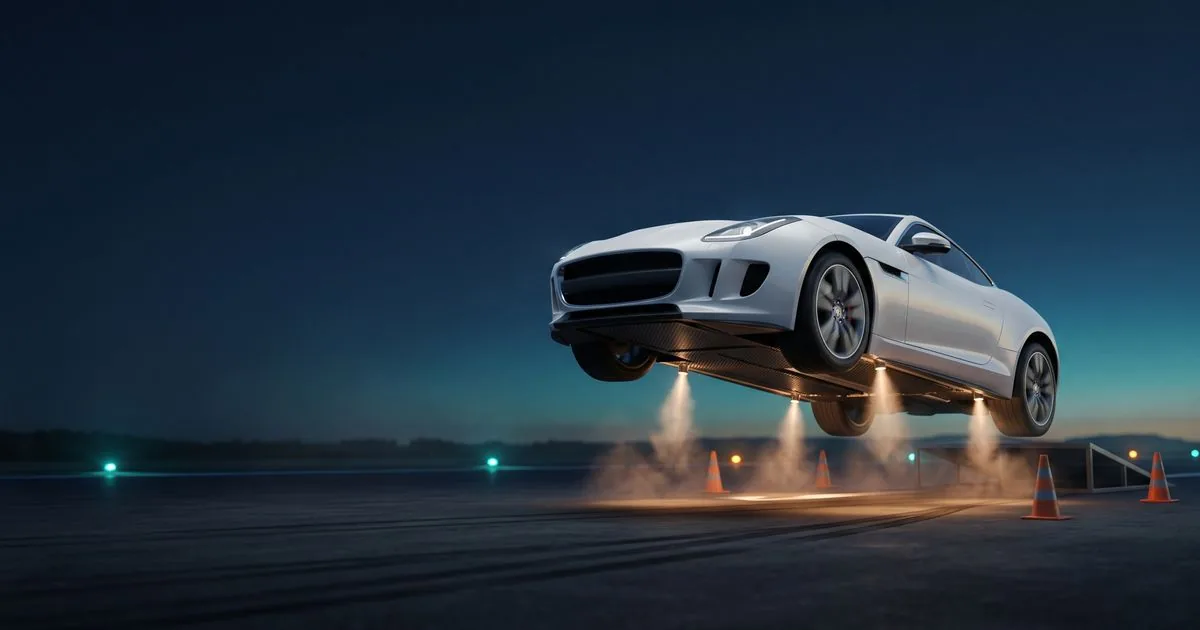
In five days, three companies occupied the same space in the news: the flying car. Tesla made a Roadster jump and spin at SpaceX’s test center in Texas. Eve, linked to Embraer, returned to the headlines with the Taubaté factory and the certification process — the transition flight, though, was on August 3. Archer flew over San Francisco Bay.
The three stories are real, but the coincidence is one of news agenda, not of calendar. The shared name hides the differences: one is a sports car with thrusters that runs a preprogrammed routine; another is an aircraft in the certification process; the third is an electric vertical-takeoff airplane that, in this demonstration, took off and landed on a runway. Putting them in the same sentence is what makes the “flying car” look closer than it is.
This post is an analysis of public sources, not a test report. We did not fly in any of the vehicles, did not visit the factory, and did not have access to documents beyond those that were published. The numbers appear as each company or outlet published them, with the date and the stated limit. The classification into stages is an editorial interpretation.
The car that jumps
Tesla’s event was on October 15, in McGregor, Texas. The car climbed an inverted ramp, hung upside down held by a suction system, jumped over other vehicles, and spun in the air before landing. The movements used ten cold-gas thrusters, fed by 600 liters of compressed air in carbon-fiber tanks, according to the company. The Thrust version, with rear thrusters, went from 0 to 60 mph in 0.81 seconds. The Rocket, with the ten thrusters, one seat, and sale by invitation, was the one that jumped.
What the event proved: the thrusters can lift, spin, and land the car in a controlled routine. What it did not prove: that a vehicle approved for public roads exists with this capability. Tesla itself says the Rocket is not approved for use on public roads. The Performance and Thrust versions are cars, with the difference that the Thrust is presented as a track version. In the sources consulted, there is no record of FAA certification for the flying version. And production in 2028 is a company target, not a contracted date.
The useful question, here, is not “when will the car fly?”, but “what exactly was certified?” The jump is an engineering feat. The flying car, as a product someone buys, parks, and drives, does not yet exist. Tesla sold the idea of a car that jumps; what it showed was a car that jumps in a demonstration.
The aircraft that needs a certificate
Eve made its first partial transition flight on August 3. The aircraft took off vertically, like a helicopter, engaged the rear thruster, and began the transition to horizontal flight, but it has not yet completed wing-borne flight. The flight lasted 3 minutes and 9 seconds, covered 0.84 nautical miles, and held 27 knots stabilized, with a peak of 30 knots on the ground, at 90 feet of altitude. The rear thruster reached 1,200 RPM.
It is a technical milestone: engaging the rear thruster in flight worked. The lift-plus-cruise configuration, with eight rotors for takeoff and fixed wings for cruise, has not yet been fully validated. What the flight did not prove: the complete transition, wing-borne flight, the complete mission, reliability at scale, certification, and commercial operation. Through October, the company had logged more than 70 flights and more than three hours of operation, with a maximum speed of 55 km/h in the air and a target of 100 km/h. The first flight with a human pilot is scheduled for the second half of 2027. Certification by ANAC, with validation by the FAA and a validation request to EASA, is scheduled for 2028.
The Taubaté factory, under construction, is the most concrete part. The investment is US$88 million, initial capacity is 120 aircraft per year, expandable to 480 with four modules, and the start should generate about 300 jobs. The break-even point, according to CEO Johann Bordais, comes at 90 to 100 aircraft per year, two to three years after certification. “We do not know how fast we will reach that level. It will depend on demand,” he told Estadão/Broadcast.
The order book is where the number needs a translation. Eve has about 2,700 aircraft in the book, from 28 customers in 10 countries, most of them in letters of intent. Estadão/Broadcast estimates the potential value of the current book at about US$500 million; with the pre-sales book, the total rises to US$13.5 billion. If the US$500 million corresponds to firm orders, at a unit price of about US$5 million, that would be approximately 100 aircraft. The math is simple and worth doing: 100 out of 2,700 is about 3.7%. The figure of 2,700 is a commercial pipeline; it is not a fleet, it is not revenue, and it is not a delivery.
Factory capacity also comes before demand. The plant was designed for 120 aircraft per year, but the company itself says expansion depends on the pace of orders. The factory proves industrial intent and the capital to produce. It does not prove that a firm market exists for 120 units a year. It is a bet ahead of demand, not a consequence of it.
For Brazil, Eve is the most concrete of the three cases: a factory under construction, an ANAC certification process, an aeronautical supply chain, and an initial customer, Revo, with a firm order for up to 50 units. But the calendar is conditional. The piloted flight is scheduled for 2027. Certification is scheduled for 2028. The first delivery is supposed to go out one week after certification. Commercial operation comes after that. There is no paying passenger in 2026.
The flight that left the runway
Archer made three flights of about 20 minutes over San Francisco Bay on October 15, with the N703AX prototype, according to Flying Magazine and the flight record it cites. The campaign covered more than 200 miles across seven cities in three days, with a peak of 131 mph. The airplane took off and landed on the runway at Oakland International Airport. Archer’s release, dated October 19, says the Midnight completed the leg from Oakland to the Marina District in about 10 minutes and, in the same text, that the flights took off and landed in Oakland. Flying says the prototype did not land in the Marina District. This text stays with the flight record: what can be checked is a landing on the runway, not in the neighborhood.
The decisive point is a different one: Archer did not demonstrate the transition from vertical flight to horizontal flight. It is the capability that defines an eVTOL and the one that separates the Midnight from a conventional electric airplane. The tour is called “No Roads,” without roads, but the aircraft used a runway. What the flights proved: the aircraft flies, the electric system works, and the range is enough for an urban leg. What they did not prove: vertical takeoff, the transition, and a vertical landing at a vertiport.
Archer has Part 135 certification, which authorizes it to operate as an airline. That is not the type certificate. The first says the company may operate; the second says the aircraft design is airworthy. Without the second, there is no paying passenger. The stated target is the Los Angeles Olympics, in 2028.
Update note (November 2, 2026): Aviation Week, on October 21, in the open portion of the article, calls the Bay campaign conventional-mode flights and a rehearsal for demonstrations in Los Angeles still in 2026. As of November 2, no completed flight in Los Angeles had appeared in the sources consulted. There is no new Eve release later than the sources already cited, and the third-quarter result was not published on this date. Tesla’s Roadster page returned 403, so the sentence about public roads remains the one from October 20.
The ladder
The three cases stand on different rungs of the same ladder:
- Demonstration: the prototype does something once, under controlled conditions.
- Test campaign: the aircraft flies repeatedly and accumulates hours.
- Type certification: the regulator approves the design and production.
- Commercial operation: the aircraft carries a passenger and generates revenue.
Tesla is on rung 1, with a production target. Eve is between 2 and 3: it flies, it accumulates hours, it has a factory under construction and a consultation on certification criteria that closed on August 18, 2026, but it does not have the certificate. Archer is on 2, with a demonstration campaign and an operating authorization that does not replace the type certificate.
| Case | What it is | What it proved | What is missing |
|---|---|---|---|
| Tesla Roadster Rocket | sports car with cold-gas thrusters | a jump and a spin with no passenger; 0 to 60 mph in 0.81 s on the Thrust version | approval for public roads, air certification, production (2028 target) |
| Eve 100 | four-passenger, one-pilot eVTOL | a partial transition flight of 3min09s and a factory under construction | type certificate (2028 target), crewed flight (2027), deliveries |
| Archer Midnight | eVTOL in development | three conventional takeoff and landing flights in the Bay Area | vertical-to-horizontal transition, type certificate, commercial operation |
The press treats the three as if they were on the same rung because the name is the same. The ladder shows why each date is different, even when every company says “2028.”
Three questions separate a promise from an operation:
- Did it take off and land vertically? “It flew” is not enough. Tesla jumped, but it is not an aircraft. Archer flew, but it used a runway. Eve began the transition, but it has not yet completed the mission.
- Is the number a firm order? A letter of intent is not revenue. Eve has 2,700 aircraft in the book, most of them in letters of intent; if the US$500 million corresponds to firm orders, the math would come to about 100 aircraft. The difference between the two numbers is the size of the risk.
- Is there a type certificate? A demonstration, a prototype, and Part 135 are not a type certificate. It is the certificate that turns a design into an airworthy product.
And a fourth, which is not technical: who operates, and who pays? The eVTOL customer is not the driver. It is an air-taxi company, an airport, a helicopter operator. Eve sells to Revo; Archer plans to operate commercially; Tesla reserves the Rocket version by invitation. The business model is part of the promise, and it almost never appears in the headline.
What 2028 means
The year 2028 appears in all three cases, but not for the same reason. For Tesla, it is the production target. For Eve, it is the certification target. For Archer, it is the Los Angeles Olympics. It is a coincidence of calendars, not a sign that the three will be ready in the same year. And all of them are targets.
For Brazil, the math is simpler. Eve is the only one of the three with a factory under construction and a certification process in the country. The first crewed flight is scheduled for 2027. Certification is scheduled for 2028. Commercial operation comes afterward. The first route should be a short leg, operated by a company such as Revo, with the four-passenger, one-pilot aircraft. It is not a car in the garage; it is a short-distance air taxi.
Range helps calibrate the expectation: the estimates vary between 85 and 90 km (Estadão) and 100 km (G1), with typical routes of about 30 km, according to Eve’s CEO. The gain is not speed. At the target of 100 km/h, a 30 km route takes about 18 minutes. The product is skipping traffic on short trips, not replacing the car.
What remains
The “flying car” is a metaphor that gets in the way. What exists is an electric vertical-takeoff aircraft, with a pilot, certification, a vertiport, and an operator. The name suggests ownership and freedom; the operation suggests aviation and scale. The difference is not semantic: it defines who can fly, where it can land, what it costs, and when.
The three October stories are real; the events they report did not all happen in the same month. What those events prove is smaller than the headline and larger than the skepticism: the technology already flies, but the product is not yet certified. The useful question is not “when will we have flying cars?” It is “which rung is this promise on?” The answer changes the date.
Sources
- First partial transition flight of the Eve 100, on August 3, 2026, with 3min09s, 0.84 nautical miles, 27 knots stabilized, a 30-knot peak on the ground, 90 feet of altitude, and 1,200 RPM on the rear thruster — Embraer, media center, the company’s own source, verified on 2026-10-20.
- ANAC industry consultation on the revised airworthiness criteria for the Eve 100, open until August 18, 2026, and a request to EASA to validate the Type Certificate — Embraer, July 20, 2026, the company’s own source, verified on 2026-10-20.
- Taubaté factory, investment of US$88 million, capacity of 120 to 480 aircraft per year, about 300 jobs, first crewed flight in the second half of 2027, certification by ANAC and validation by the FAA in 2028, first delivery to Revo, break-even at 90 to 100 aircraft per year, estimated range of 85 to 90 km, typical routes of about 30 km, and 66 flights through August — Estadão/Broadcast, August 21, 2026, a news report with company data, verified on 2026-10-20.
- Order book of about 2,700 aircraft, 28 customers, 10 countries, US$13.5 billion in potential value, about US$500 million in the current book, and a unit price of about US$5 million — Estadão/Broadcast, August 21, 2026, a news report with company data, verified on 2026-10-20.
- More than 70 flights and more than three hours of operation through October, commercial production planned for the end of 2028, and capacity of 120 to 480 units per year — Época Negócios, October 16, 2026, a news report with company data, verified on 2026-10-20.
- Lift-plus-cruise configuration, eight rotors, fixed wings, rear thruster, four passengers and one pilot, range of up to 100 km, and six certification prototypes in São José dos Campos — G1, September 11, 2026, a news report with company data, verified on 2026-10-20.
- Second-quarter 2026 results, with an order book of approximately 2,700 units and US$13.5 billion in non-binding value at list price — Eve Air Mobility, August 4, 2026, the company’s own source, verified on 2026-10-20.
- Three flights of about 20 minutes by the N703AX prototype, takeoff and landing on the Oakland runway, no landing in the Marina District, no demonstration of the vertical-to-horizontal transition, Part 135 certification without a type certificate, and a commercial-service target at the Los Angeles Olympics — Flying Magazine, October 19, 2026, a specialist report, checked again on 2026-11-02.
- Archer release of October 19, 2026: piloted flights with takeoff and landing in Oakland, and the sentence saying the Midnight completed the leg to the Marina District in about 10 minutes. Los Angeles remained a plan — Archer Aviation, the company’s own source, verified on 2026-11-02.
- Campaign in conventional mode and a rehearsal for demonstrations in Los Angeles still in 2026, in the open portion of the article — Aviation Week, October 21, 2026, a specialist report, verified on 2026-11-02. The rest of the page is behind a subscription and did not enter this text.
- Campaign of more than 200 miles across seven cities in three days and a peak of 131 mph — AIN, October 19, 2026, a specialist report, verified on 2026-10-20.
- Roadster with ten cold-gas thrusters, 600 liters of compressed air, Thrust version with 0 to 60 mph in 0.81 seconds, and Rocket version with one seat and sale by invitation — TechCrunch, October 15, 2026, a technology report, verified on 2026-10-20.
- Preprogrammed routine, suction system, carbon-fiber tanks, Performance version as a street car, Thrust as a track version, and production in 2028 — technology.org, October 20, 2026, a technology report, verified on 2026-10-20.
- Performance, Thrust, and Rocket configurations, cold-gas thrusters, suction system, and the information that the Rocket is not approved for use on public roads — Tesla, Roadster page, the company’s own source, verified on 2026-10-20. On 2026-11-02 the page returned 403 and was not reread.