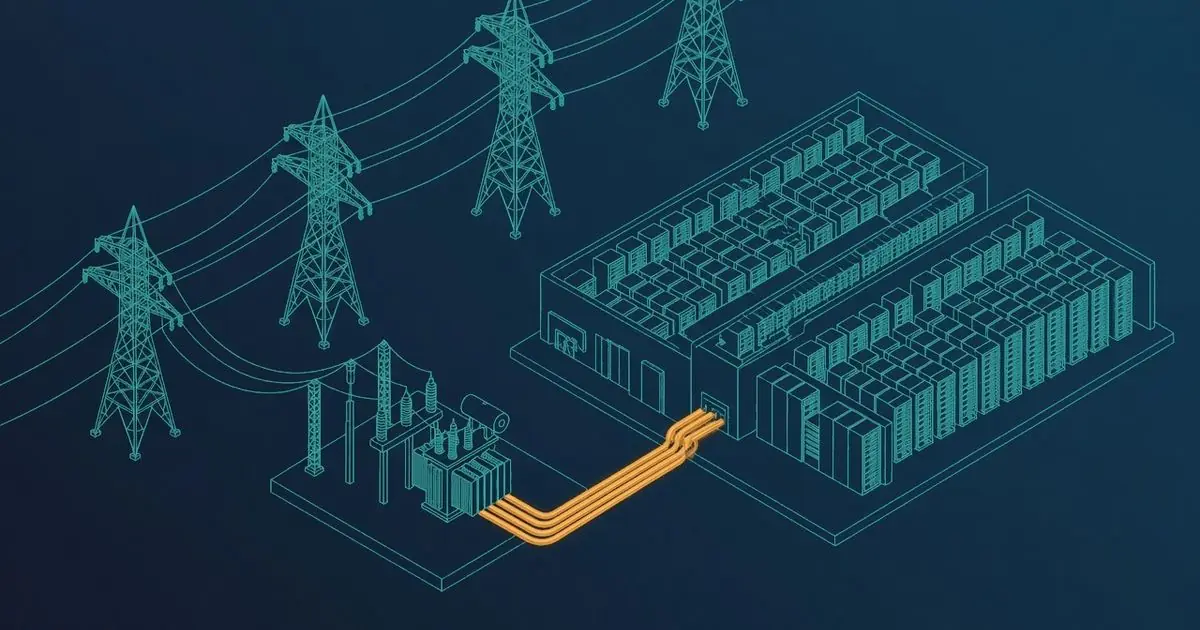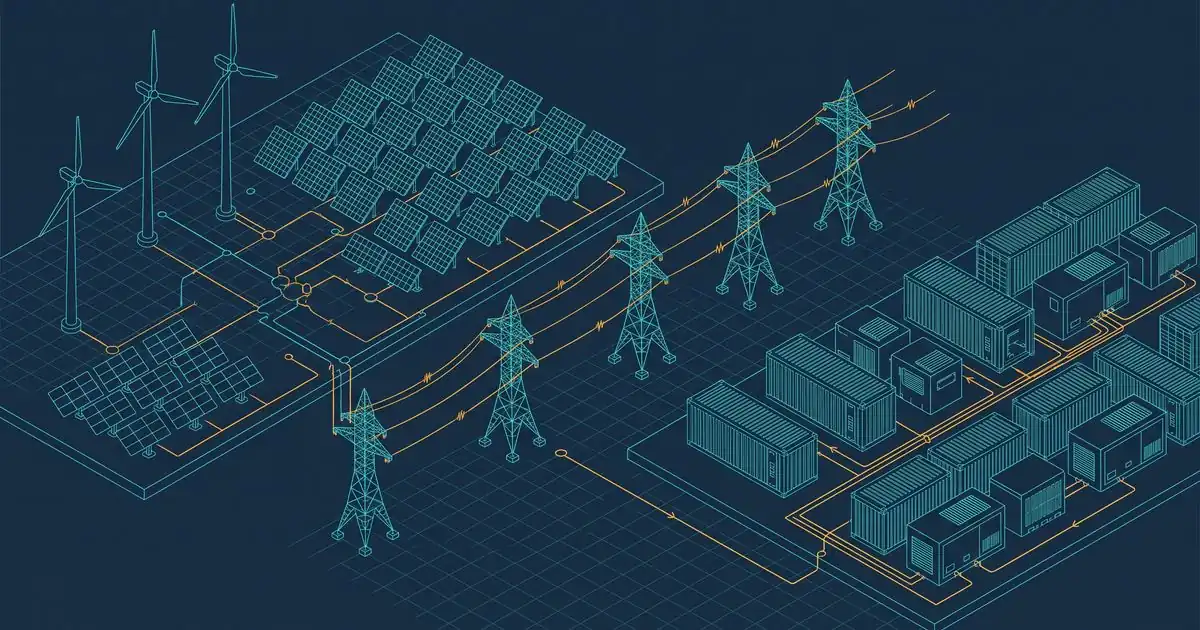
Between January 1 and April 30, 2026, wind and photovoltaic plants had an estimated unrealized generation, according to the National Electric System Operator (ONS; Operador Nacional do Sistema Elétrico), of 8,233,089.7 MWh, or 2,858.7 average MW, 17.17% of the reference generation. Average MW is the energy accumulated over the period divided by the hours of the period; it is not installed capacity. The calculation uses only open data from the ONS. The scope is the plants classified in the Type I, Type II-B, and Type II-C modalities — ONS plant-classification modalities; it is not the total of the National Interconnected System (SIN).
In October 2026, the National Electric Energy Agency (ANEEL; Agência Nacional de Energia Elétrica) made two decisions that intersect: on the 6th, the rule that organizes curtailments; on the 27th, notices No. 05/2026 and No. 06/2026 of the Power-Based Capacity Reserve Auction (LRCAP; Portuguese: Leilão de Reserva de Capacidade na forma de Potência) for battery energy storage systems (SAE). The rule deals with who gets curtailed; the auction contracts batteries for reserve. The effect on curtailment is conditional: connection point and recharging hours.
What generation curtailment is and why the operator restricts
Generation curtailment is the reduction or interruption of a plant’s output on ONS instruction, even when the plant is ready to generate. Energy is produced at the instant of consumption; with generation above load, restricting is one of the operator’s responses.
For the ONS, restriction is a structural reality in countries with a high share of renewables, whose output varies and does not always coincide with peak consumption, and a technical measure to preserve the security of the National Interconnected System (SIN).
Restriction reasons in the ONS data
In the field cod_razaorestricao, the ONS dictionary lists ENE — “Razão energética” (Energy reason), CNF — “Razão de atendimento a requisitos de confiabilidade” (Reliability-requirement compliance reason), REL — “Razão de indisponibilidade externa (elétrica)” (External unavailability reason (electric)), and PAR — “Restrição indicada no parecer de acesso” (Restriction stated in the access opinion). Canal Solar, on May 18, 2026, explains ENE as “a carga do sistema não consegue absorver toda a energia disponível para despacho” (the system load cannot absorb all the energy available for dispatch), CNF as curtailments “relacionados à necessidade de preservar a segurança operativa do sistema” (related to the need to preserve the operational security of the system), and REL as restrictions “normalmente associadas à falta de capacidade de transmissão para escoamento da energia gerada” (normally associated with the lack of transmission capacity to carry the generated energy). The PAR code does not appear in the January–April 2026 totals.
Asked whether, in his routine, curtailment orders arrive more because of excess energy or because of a line limit, the author answers: “Atualmente é por sobra de energia devido a MGD” (“Currently it is because of excess energy due to MGD”) — MGD being micro and mini distributed generation (MMGD).
In the recalculation data, the energy reason makes up about 62% of the total from January to April 2026. The number is consistent with the author’s statement, but the ONS base does not identify the MMGD as the cause.
How to recompute the scale of the curtailment
The raw data are on the ONS Open Data Portal, in two monthly datasets, one wind and one photovoltaic, of restriction by constrained-off (the ONS term for generation restriction on operator instruction), with CSV, XLSX, and PARQUET, at half-hourly level, for the Type I, Type II-B, and Type II-C modalities. The procedure on November 8, 2026:
- Download the dictionary and the Jan–Apr 2026 CSVs (
RESTRICAO_COFF_EOLICA_2026_01.csvto_04.csv;RESTRICAO_COFF_FOTOVOLTAICA_2026_01.csvto_04.csv). - Read UTF-8 without a byte-order mark (BOM), semicolon separator with quotes respected, including line breaks inside quotes, decimal point.
- Use
din_instante,val_geracao,val_geracaoreferencia,val_geracaonaorealizadaapurada, andcod_razaorestricao. - Each record is a 0.5-hour step.
- Sum
val_geracaonaorealizadaapuradatimes 0.5 hours (empty = not computed, not summed). - Divide by 2,880 hours for average MW.
- Divide by the sum of
val_geracaoreferenciatimes 0.5 hours in all rows with a reference.
In the ONS dictionary, reference generation is the estimate of how much the plant or group could generate without limitation (the mechanisms of RO-AO.BR.13, in the Operations Procedures Manual (MPO)). GNRa is the estimate of “frustrated generation” per the ONS dictionary (“geração frustrada”), the difference between reference and verified generation, floored at zero, only in periods with a limitation. The denominator uses all 1,312,848 rows, because all carry a reference and the dictionary does not limit that field to restricted steps; val_geracaoreferenciafinal, only for REL, is not included in the sum.
Checks: wind, 882,960 rows; photovoltaic, 429,888; 24 columns per file, no divergent record. There are 909,594 steps with no computed GNRa, none with a reason code.
In the recalculation of November 8, 2026, the sum gave 8,233,089.7 MWh, or 2,858.7 average MW: ENE 1,783.1; CNF 651.4; REL 424.1; wind 1,817.0; solar 1,041.7; 17.17% of the total reference of 47,956,679 MWh. Filling empty values by reference minus verified where there is a code does not change the total: no step with a code was left uncomputed.
| Measure | Our recalculation (CSVs of November 8, 2026) | Canal Solar (May 18, 2026) |
|---|---|---|
| Total average MW | 2,858.7 | 2,843 |
| ENE average MW | 1,783.1 | 1,772 |
| CNF average MW | 651.4 | 651 |
| REL average MW | 424.1 | 420 |
| Wind average MW | 1,817.0 | 1,806 |
| Solar average MW | 1,041.7 | 1,037 |
| Percentage | 17.17% of reference generation | 17.2% of the potential generation of the affected plants |
Our recalculation sits 15.7 average MW above, a difference of 0.6% on the total. The report was published on May 18, 2026 and does not state the data-extraction date; the recalculation used the CSVs downloaded on November 8, 2026. The denominators are described differently (reference generation in the recalculation; potential generation of the affected plants in the report); whether they are equivalent was not verified. The calculation program and the SHA-256 sums of the files are in the evidence extract.
Evidence 1: the new rule organizes the order of curtailment
On October 6, 2026, ANEEL approved the rule that organizes generation curtailment, ending the debate of Public Consultation No. 45/2019. In energy curtailments, it instructs the ONS to prioritize cost relief and the order among sources, with shared curtailments, progressively.
The hydraulic component associated with turbinable spilled energy (EVT) enters over four years, in steps of 25%, 50%, 75%, and 100% of the share set in the final model. In electric curtailments, the ONS acts where it is most effective, with the impact spread among eligible agents. The proposal keeps permanent independent auditing of the ONS’s measurement of the events, according to ANEEL.
The shadow period is the phase in which the impacts of the rule are simulated before it takes effect, per ANEEL. The shadow period begins 180 days after the resolution is published, lasts 12 months, and the definitive application occurs 18 months after publication.
Evidence 2: the December battery auction contracts power availability
On October 27, 2026, ANEEL approved notices No. 05/2026 and No. 06/2026 of the LRCAP, aimed at energy storage systems (SAE), with bids on December 2 and 4, 2026.
The product is power availability (MW), starting August 1, 2028, with a 15-year supply and payment by a fixed annual revenue adjusted for performance. Delivery is maximum power for 4 hours per cycle, up to 2 daily cycles, up to 366 cycles per year, with full recharging (0% to 100%) within six hours. BNDES describes the goal as contracting available power for the reliability and operational security of the SIN. The ANEEL news story does not mention a link between recharging and curtailment hours.
The theoretical maximum discharge of the contract
The calculation uses only ANEEL parameters and measures the theoretical maximum discharge, not avoided curtailment.
Assumptions: a constant 100 MW, full 4-hour cycles, no losses, degradation, or penalties. The ANEEL story gives the limit of up to 2 cycles per day and does not say how many will be called nor does it fix recharging in hours of surplus. One full cycle: 100 MW times 4 hours gives 400 MWh. Two cycles in the day: 800 MWh. Annual ceiling: 366 times 400 MWh gives 146,400 MWh, in 183 days on the 2-daily-cycle routine.
As an order of magnitude, the one-year ceiling of a hypothetical 100 MW contract (146,400 MWh) equals 1.78% of the roughly 8.23 million MWh curtailed in four months; the periods differ.
Auction price and cost allocation
On October 19, 2026, the Energy Research Company (EPE; Empresa de Pesquisa Energética) published the price-ceiling calculation methodology. The October 19 note did not anticipate the values. According to EPE, the Reference Marginal Cost (CMR) is the reference value used to set the maximum price; it does not determine the final price, which is formed by competition. This text did not verify whether the values were published after October 19.
The ANEEL news story of October 27, 2026 states the principle: the costs of capacity reserve with batteries will be allocated only among generators, per agency regulation. Canal Solar reported on November 4, 2026 that ANEEL was discussing the cost-allocation base and the ERCAP (Capacity Reserve Power Charge) allocation methodology in Public Consultation No. 37/2026. According to Canal Solar, the contribution deadline ran until November 6.
Counterpoint: a battery shifts energy in time; the grid decides the path
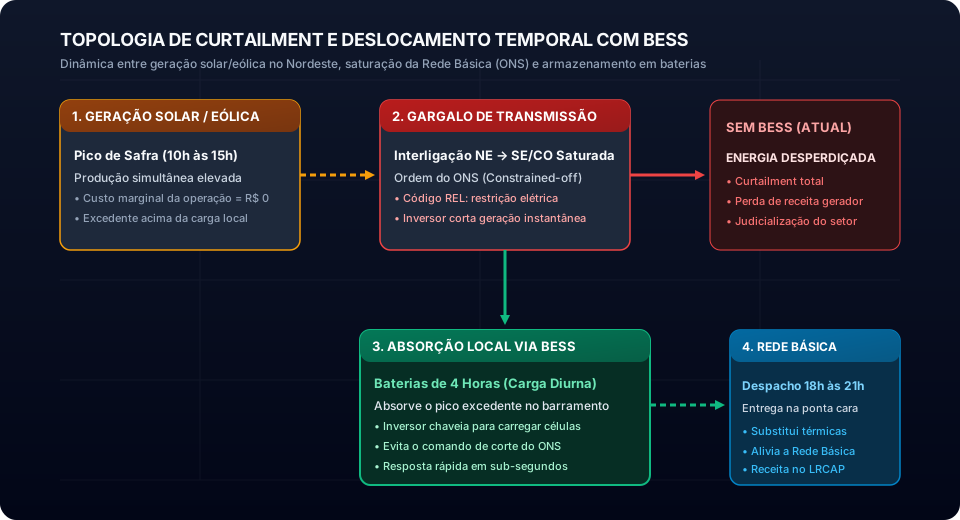
A battery stores energy to deliver at another moment within the point where it is connected. It does not create a new transmission corridor. In a meshed grid, the effect depends on electrical location, flows, and operations. For a specific restriction, the battery tends to help when it is electrically on the side of the restricted generation. Recharging in scarcity hours can cancel that help.
In the energy reason (ENE, 1,783.1 average MW, about 62% of the total), what would matter is having load or storage to absorb the surplus in the hour. In the CNF and REL reasons (651.4 and 424.1 average MW, together about 38%), electrical location relative to the restriction would weigh more.
In the text on AI’s electric wall, data centers sign deals to reactivate nuclear plants. That is a decision about firm supply. The December auction deals with a different product: power availability by the hour.
Method: how to read a curtailment headline
| Question | Indicator | Where to check | What it does not prove |
|---|---|---|---|
| Was there a restriction, and when and for how long? | Time, duration, and source | ONS: curtailment page and Open Data Portal | That another decision would have avoided the curtailment |
| Was the curtailment from surplus or from the grid? | Nature declared by the ONS | ONS: curtailment page and Open Data Portal | That all surplus would fit in the grid |
| Who was curtailed and in what order? | Allocation rule, shadow period, EVT | ANEEL, October 6 rule | That operations changed |
| Does the battery solve it? | MW, hours, cycles, connection point | ANEEL, October 27 notices | That the bottleneck disappeared |
| Is the auction price revenue? | Bid revenue, performance, degradation | EPE and ANEEL, October 27 notices | Guaranteed profit for the winner |
The dictionary refers reference generation to the RO-AO.BR.13 routine of the Operations Procedures Manual (MPO); a change in that kind of document can alter the calculation. Keeping track of selected ONS norms is the role of Sentinela, which detects when a document on the list changes and prepares the draft report. The connection margin is the available capacity to connect new load or generation at a point on the Basic Network; the data-center access queue shows how it constrains large projects.
Limits of this analysis
This piece does not estimate how much of the curtailed generation the batteries will avoid, nor does it model price, degradation, recharging, or the tariff effect of the allocation. The full text of notices No. 05/2026 and No. 06/2026 was not read; claims about the notices come only from the ANEEL news story of October 27, 2026. The recalculation used the CSVs and dictionary downloaded on November 8, 2026; 2025, regions, states, or plants were not recomputed, nor were XLSX and PARQUET crossed. The numbers are the ONS’s own estimates, not measurements of wasted energy. The ONS data may be updated; a future recalculation may differ.
The bottom line
The new rule organizes the order and allocation of curtailment, with a shadow period and auditing; the auction contracts availability for reserve, with defined hours, cycles, and recharging. The two can complement each other when recharging falls in surplus hours and the equipment sits on the right side of the bottleneck. A battery shifts energy in time; the grid decides whether that time arrives.
Sources
- ANEEL, 10/06/2026, “ANEEL aprova regra para organizar cortes de geração”, https://www.gov.br/aneel/pt-br/assuntos/noticias/2026/aneel-aprova-regra-para-organizar-cortes-de-geracao, accessed on 11/08/2026.
- ANEEL, 10/27/2026, “Editais Nº 05/2026 e Nº 06/2026 dos leilões de Armazenamento de Energia são aprovados pela ANEEL”, https://www.gov.br/aneel/pt-br/assuntos/noticias/2026/editais-no-05-2026-e-no-06-2026-dos-leiloes-de-armazenamento-de-energia-sao-aprovados-pela-aneel, accessed on 11/08/2026.
- EPE, 10/19/2026, “EPE publica metodologia para cálculo do preço-teto dos leilões de armazenamento de energia”, https://www.epe.gov.br/pt/imprensa/noticias/epe-publica-metodologia-para-calculo-do-preco-teto-dos-leiloes-de-armazenamento-de-energia, accessed on 11/08/2026.
- ONS, Curtailment page, “Curtailment – informações sobre a gestão de excedentes energéticos”, https://www.ons.org.br/Paginas/faq_curtailment.aspx, accessed on 11/08/2026.
- ONS, Open Data Portal, constrained-off restriction datasets, https://dados.ons.org.br/dataset/restricao_coff_eolica_usi and https://dados.ons.org.br/dataset/restricao_coff_fotovoltaica, accessed on 11/08/2026.
- Recalculation of 11/08/2026 from the ONS CSVs: evidence extract with the calculation program, the SHA-256 sums of the files, the formulas and the results.
- BNDES, LRCAP 2026 page, “Leilão de Reserva de Capacidade na forma de Potência (LRCAP) 2026”, https://www.bndes.gov.br/wps/portal/site/home/financiamento/servicos-online/credenciamento-de-equipamentos/leilao-reserva-capacidade-forma-de-potencia-lrcap-2026, accessed on 11/08/2026.
- Canal Solar, 11/04/2026, “ONS orienta projetos de baterias para leilão de capacidade”, https://canalsolar.com.br/ons-orienta-projetos-baterias-leilao-capacidade/, accessed on 11/08/2026.
- Canal Solar, 05/18/2026, “Brasil já cortou quase 3 GW médios de energia solar e eólica em 2026”, https://canalsolar.com.br/brasil-cortou-tres-gw-medios-energia-solar-eolica/, accessed on 11/08/2026.